First Formal Meeting of Supporting Nations Set for November 9-12 in Vientiane, Laos
Bangkok - The new treaty banning cluster bombs, which took effect just three months ago, has already made impressive strides in eradicating the weapon, Human Rights Watch said today. Seven countries have finished destroying their stockpiles of cluster munitions, two have cleared all contaminated land, and 10 have enacted national legislation to enforce the treaty.
The Convention on Cluster Munitions was negotiated in May 2008, opened for signature in December 2008, and, after achieving the required 30 ratifications, entered into force and became binding international law on August 1, 2010 – a very rapid pace for a multilateral agreement. A first report on progress to date, “Cluster Munition Monitor 2010,” was released on November 1 in Bangkok.
“We’ve made more progress, more quickly, than anyone thought possible just a few years ago,” said Steve Goose, Arms Division director at Human Rights Watch. “There is clearly a strong commitment to get rid of the weapon and to deal urgently with the ongoing threat to civilians.”
The Convention on Cluster Munitions prohibits the use, production, and transfer of cluster munitions, requires destruction of stockpiled cluster munitions within eight years and clearance of land contaminated by the weapon within 10 years, and provides for assistance to victims of cluster munitions.
A total of 108 nations have signed the convention, 43 of which have now ratified, becoming full states parties to the agreement. According to “Cluster Munition Monitor 2010,” 38 of the nations that have signed the convention are former users, producers, exporters, or stockpilers of the weapon.
The convention’s First Meeting of States Parties will be held in Vientiane, Laos from November 9-12. Laos is the country most severely affected by cluster munitions as a result of the US bombing campaign during the Vietnam War.
“Cluster Munition Monitor 2010” contains information about cluster munition policy and practice in every country of the world, including major powers that have not yet joined the convention such as Brazil, China, India, Israel, Pakistan, South Korea, Russia, and the United States.
“No nation should turn its back on this convention, the most important humanitarian and disarmament agreement of the past decade,” Goose said. “The inherent dangers to civilians far outweigh any limited military usefulness of cluster munitions.”
Cluster munitions were banned because of their indiscriminate impact at the time of use and the long-lasting danger they pose to civilians after use. These munitions, which can be fired by artillery and rocket systems or dropped by aircraft, typically explode in the air and spread dozens, even hundreds, of tiny submunitions over an area the size of a football field. In addition, submunitions often fail to explode on initial impact, leaving duds that act like landmines for months or years to come.
The Obama administration has not reviewed or altered the Bush administration policy, which commits the US not to use cluster munitions that have a failure rate of more than one percent, beginning at the end of 2018, in essence banning all but a tiny fraction of the existing arsenal. The US has not confirmed or denied a credible allegation that it used at least one cluster munition in Yemen in December 2009, which according to "Cluster Munition Monitor 2010" is the only reported use of cluster munitions worldwide in 2009 or 2010.
Other major findings in “Cluster Munition Monitor 2010” include:
•The seven countries that have already completed destruction of their stockpiles collectively destroyed more than 13.8 million submunitions contained in 176,000 cluster munitions. At least 11 other countries have started destroying their stocks. •Over the past six decades cluster munitions have been used in 39 countries and areas by at least 18 governments. •Fifteen former producers of cluster munitions have joined the convention, but 17 countries continue to produce, or reserve the right to produce, these weapons in the future. •There were no recorded transfers of cluster munitions in 2009 or 2010, other than inert components from South Korea to Pakistan. Two countries that have not signed the treaty, the US and Singapore, have instituted a moratorium on exports of cluster munitions. •At least 23 countries are affected by cluster munition contamination, including 14 that have joined the convention, as well as three disputed areas. •At least 38 square kilometers of land were cleared of cluster munition remnants in 2009, with more than 55,156 unexploded submunitions destroyed. •Albania and Zambia, both states parties to the treaty, have announced the completion of their clearance programs. •By the end of 2009, 16,816 cluster munition casualties had been recorded in at least 27 states and three disputed areas, but due to significant underreporting, the actual number of cluster munition casualties might be as high as 85,000 worldwide. •In 2009, there were 100 new confirmed cluster munition casualties in nine countries and one disputed area. Half of these casualties occurred in Laos and Lebanon, both of which have joined the convention.
“Cluster Munition Monitor 2010” is a product of the Nobel Peace Prize-winning International Campaign to Ban Landmines (ICBL) and of the Cluster Munition Coalition (CMC). Human Rights Watch is a founding member of both the ICBL and CMC. The Cluster Munition Monitor report is the sister publication to the Landmine Monitor report, which has been issued annually since 1999. The Landmine Monitor project was renamed Landmine and Cluster Munition Monitor in 2010.
Brazil has reached a new milestone with the election of its first-ever female president. On Sunday, Dilma Rousseff defeated rival José Serra with 55 percent in a runoff vote. Rousseff was outgoing Brazilian President Luiz Inácio Lula da Silva’s chosen successor after serving the last five years as his chief of staff. During the 1960s and 1970s, she was involved in the armed struggle against Brazil’s military dictatorship. She was imprisoned for nearly three years and tortured. Among her pledges, Rousseff vowed to eradicate chronic poverty in Brazil affecting 20 million people. We talk with Michael Fox, an independent journalist and documentary filmmaker based outside Porto Alegre. "She’s a fighter," Fox says.
Baghdad — Iraq's dwindling Christian community was grieving and afraid on Monday after militants seized a Baghdad church during evening Mass, held the congregation hostage and triggered a raid by Iraqi security forces. The bloodbath left at least 58 people killed and 78 wounded – nearly everyone inside.
The attack, claimed by an al-Qaida-linked organization, was the deadliest ever recorded against Iraq's Christians, whose numbers have plummeted since the 2003 U.S.-led invasion as the community has fled to other countries.
Outside Our Lady of Salvation church, Raed Hadi leaned against the car carrying his cousin's coffin, waiting for the police to let him bury him on church grounds.
"It was a massacre in there and now they are cleaning it up," he said Monday morning. "We Christians don't have enough protection. ... What shall I do now? Leave and ask for asylum?"
"Now they make a show," said Jamal Jaju, who watched as Iraqi forces pushed back observers. "What can I say? I lost at least 20 friends in there."
Pope Benedict XVI denounced the assault as "ferocious" and called for renewed international efforts to broker peace in the region.
Prime Minister Nouri al-Maliki also condemned the siege, saying it was an attempt to drive more Christians out of the country.
Islamic militants have systematically attacked Christians in Iraq since the collapse of Saddam Hussein's regime, effectively chasing more than 1 million people out of the country, according to estimates from an adviser to Iraq's top Catholic prelate, Chaldean Cardinal Emmanuel III Delly. He shared the figures with The Associated Press on condition of anonymity because he was not authorized to talk to the media.
In an interview, the cardinal encouraged the country's remaining 1.5 million remaining Christians not to be driven off by the militants.
Sunday's carnage began at dusk, when a deadly car bomb went off in the area. Militants wearing suicide vests and armed with grenades then attacked the Iraqi stock exchange, injuring two guards.
The car bombing and the attack on the stock exchange may have been an attempt by the militants to divert attention from their real target – the nearby church in an upscale Baghdad neighborhood.
That attack soon followed. The gunmen went inside the church and took about 120 Christians hostage.
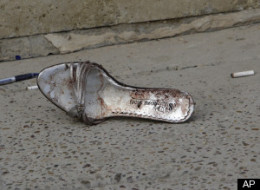
At least 58 people were killed, including 12 policemen as well as five bystanders thought to have been killed by the car bombing and blasts outside the church before the attackers stormed inside. Forty-one Christians inside the church also died, including two priests. Iraqi officials had initially provided a much lower death toll.
Witnesses said hostages died both before and during the rescue. They described a terrifying scene in which they desperately tried to shield themselves from the violence.
One parishioner, Rauf Naamat, said militants began by throwing several grenades and spraying the crowd inside the church with gunfire. After the initial violence and chaos died down, the militants walked up to the priest leading the mass, told him to lie down and shot him, he said.
An Iraqi official said he talked on a cell phone with one of the hostages during the siege. He said the hostage described how insurgents began shooting wildly when they went into the church and that he could see about 40 wounded people lying around him on the floor.
During the hours that followed, an eerie quiet descended on the building, punctuated only by quiet weeping, according to Naamat.
"Most people were too afraid to produce a sound. They feared militants would kill them if they heard them," Naamat said.
Naamat said he heard one of the attackers talking to what he thought was Iraqi security, threatening to blow themselves up if Iraqi forces stormed the building.
The Iraqi official who spoke by phone with one of the hostages said he also had a four-minute phone conversation with a militant, who demanded that authorities release all al-Qaida-linked prisoners starting with the women. The official said he judged by the militant's accent and speech that he was not Iraqi.
The militants also called an Egyptian television station, al-Baghdadia, during the hostage siege, repeating their demand that their colleagues be released.
When Iraqi special forces joined police and other officials already on the scene, they heard gunshots and decided to enter the church "to prevent the further loss of innocent lives," said Lt. Col. Terry L. Conder, a spokesman for U.S. special forces.
Naamat said the lights went out – turned off by Iraqi forces surrounding the building – and he heard the voices of Iraqi forces saying: "We will save you," as they entered the building wearing black uniforms and carrying rifles.
He said he then saw a militant approach the security forces as they made their way to the alter. The militant blew himself up, unleashing a massive blast.
The Iraqi official said that when the security forces stormed the church, the militants were shooting at the hostages.
According to two security officials, most of the deaths took place in the basement where a gunman killed about 30 hostages when Iraqi forces began to enter the church. One official said the gunman set off an explosives vest he was wearing, but the other said the gunman threw two grenades at his hostages.
A member of the commando force that went into the church said security forces found three explosives vests and grenades.
The officials spoke on condition of anonymity because they were not authorized to talk to journalists.
Video footage from an American drone showed a black plume of smoke pouring out of the church followed by flashes before security forces charged inside. U.S. forces often supply air support to Iraqi forces conducting operations on the ground, feeding them video footage from their aircraft.
Conder said Iraqi forces rescued 70 hostages, and Baghdad military spokesman Maj. Gen. Qassim al-Moussawi said they arrested five suspects, some of whom were not Iraqi.
Others, however, questioned whether the raid was wise.
Younadem Kana, a Christian member of the Iraqi parliament, condemned the operation as "hasty" and "not professional."
"We have no clear picture yet whether the worshippers were killed by the security forces' bullets or by terrorists, but what we know is that most of them were killed when the security forces started to storm the church," Kana said.
About 4 1/4 hours passed between the car bombing and the end of the siege shortly after 10 p.m., said an American military official, who spoke on condition of anonymity because he was not authorized to discuss the matter.
A cryptically worded statement posted late Sunday on a militant website allegedly by the Islamic State of Iraq appeared to claim responsibility for the attack.
The group, which is linked to al-Qaida in Iraq, said it would "exterminate Iraqi Christians" if Muslim women in Egypt were not freed.
It specifically mentioned two women that extremists maintain have converted to Islam and are being held against their will in Egypt.
Iraqi authorities on Monday took extra measures to protect Christian neighborhoods and churches in Mosul, Kirkuk and Baghdad. Additional police cars and checkpoints were seen near many churches, and authorities were conducting extensive searches on cars and pedestrians heading to churches.
"This is more than a tragedy," said Iraq's Human Rights minister, Wijdan Mikheil, who is a Christian.
Choking back tears as she spoke with reporters outside Our Lady of Salvation church, she said: "What is happening to Iraqis in general and Christians in particular is an attempt to push them out of the country, but we hope Iraqis remain united."
Our Lady of Salvation is a Syrian Catholic church.
Karim Khalil, a 49-year-old Iraqi Christian, said he moved to Syria with his family last year because he felt his religion made him a target in Baghdad.
"Iraqi militias threatened me, saying I was on the side of the Americans because I am Christian," Karim told the AP. "They said I would be killed if I stayed in Iraq."
Now he lives in Damascus with his wife and five children.
"I have left behind my house and everything to escape with my family," he said.
Many other Iraqi Christians living in Syria refused to speak to the AP. They said they fear militias may exact revenge on their families in Iraq.
 Human Rights Watch: