On Wednesday, July 28, Joe appeared as a guest on Metro Morning with host Matt Galloway. Every weekday morning from 5:30 to 8:30 a.m. Galloway, a CBC radio host for more than six years, talks about the issues most important in Toronto today.
In Joe’s interview with Galloway, the focus of the discussion was on Joe’s vision for transportation in Toronto. Joe explained why he supports Transit City as the best solution for getting Toronto moving, and how he also supports a city with bike lanes on major routes, such as Jarvis St.
First the previous Labour/Tony Blair government's invovlement in the release of Abdel Baset al-Megrahi, and now Labour's shadow cabinet opposing the referendum on electoral reform. Although proportional representation currently isn't included in the referendum, the fact that Labour would oppose anything other than the current undemocratic and antiquated first-past-the-post electoral system is a slap in the face to the British electorate.
The Labour shadow cabinet has decided to vote against a bill introducing reform to the voting system, raising the prospect of a Commons defeat for one of the governing coalition's flagship policies.
The decision, taken last night, followed two lengthy shadow cabinet discussions.
It could herald a backbench Tory-Labour alliance designed to derail the bill either at its second reading or by rejecting the proposal that the referendum be held on the same day as elections in Scotland, Wales and parts of England next May.
A total of 50 Tory MPs are opposing next May as the date for the referendum, and are coming under intense pressure from Tory whips to pull back from that stance.
The shadow cabinet had an earlier discussion at which – on the advice of John Denham, the shadow communities and local government secretary – it proposed abstaining on the bill.
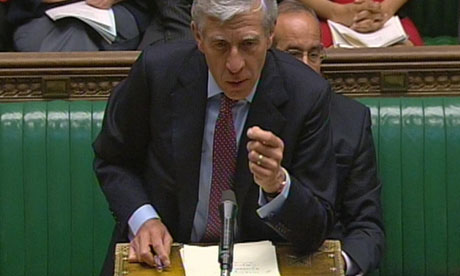
But Denham, a strong advocate of voting reform, backed moves at yesterday's shadow cabinet, led by its justice spokesman, Jack Straw, to oppose the bill outright.
Straw argued that the bill introducing the referendum was being coupled unnecessarily with boundary changes which he described as gerrymandering.
The shadow cabinet agreed yesterday that it still supported the referendum the Alternative Vote (AV) system – but, in a new reasoned amendment, will say it is entirely wrong that this reform, on Conservative insistence, is being bound up with plans to reduce the number of MPs and introduce widespread boundary changes.
Labour claims the boundary reforms would benefit the Tories so much that the Labour party would find it impossible to win a general election again.
Denham's decision to oppose the coalition bill is significant because he is one of the most long standing supporters of AV in the Labour party.
Under the AV system, voters rank candidates in order of preference until one of them reaches 50% or more of first-choice votes and is elected.
Supporters claim the system will end the culture of safe seats and lazy MPs, but there is no agreement about which party will benefit most.
There is fury in Labour ranks that the previous process of independent public inquiries has been removed from the boundary review process.
Labour MPs also claim a government minister will be given powers in the bill to change boundary review recommendations without an appeal mechanism.
The coalition claims the period of consultation is being extended, but Tory MPs yesterday expressed strong concern that the pre-eminent requirement to equalise the size of constituencies would see old countryside boundaries, such as Somerset, ignored.
However, the coalition insists the boundary review – due to be completed before the next election – is necessary to cut the number of MPs to 600 and attempt to equalise the size of constituencies.
Mark Harper, the constitutional affairs minister, hit back at Straw's complaints, saying: "All this bluster simply highlights the fact that Labour MPs do not believe in seats of equal size and votes counting equally across the whole of the United Kingdom."
The potential parliamentary roadblock to a referendum stems from a deal the deputy prime minister, Nick Clegg, struck with David Cameron as part of the coalition talks.
The two agreed a referendum on AV would go ahead, but only on the condition that the boundary review was completed in time for the next election. Both proposals have been included in a single bill.
Many Labour and Tory MPs are angry that the referendum is set to be held on the same day as the Scottish, Welsh and English local elections.
A total of 45 disaffected Conservative MPs, led by Bernard Jenkin, John Redwood, Edward Leigh, Sir Malcolm Rifkind and David Davis, have signed an early day motion saying it is wrong to hold the referendum and elections on the same day.
They could combine with Labour to inflict the first serious defeat for the government on an issue of acute sensitivity for the coalition's internal political balance.
One shadow cabinet member who supports AV said yesterday: "I am going to be put in the impossible position next May of campaigning to remove the Liberal Democrats on my local council three days of the week, and then join forces with the same Liberal Democrats to call for a change in the voting system for the Commons for the remaining days of the week. It is totally incoherent."
The chairwoman of the electoral commission, Jenny Watson, has said she will rule in September on whether she thinks the referendum and local elections should take place on the same day, but indicated she did not believe it was an insurmountable problem and said she had given the proposal an amber light.
But in a sign of anger on the Tory benches, the rightwing backbencher Edward Leigh warned Clegg in the Commons: "If we had had the alternative vote in 1997, the Conservative party would have been reduced to a pathetic rump of 65 MPs.
"Does he not think that, precisely because AV is not proportional, it raises complicated questions? It is extraordinarily dangerous, therefore, to have the referendum on the same day as other elections, namely the Scottish elections. We need a proper debate on the issue."
Clegg repled: "About 39 million people will be invited to vote next May, and it seems to me that, instead of asking people to constantly go back to polling booths to cast separate votes, it is perfectly right to invite them to have their say on a simple yes/no issue on the same day – at, by the way, a lower cost to the exchequer. It will save about £17m."
Finally someone has come to their senses in regards to this draconian law.
From the Associated Press:
Phoenix — A federal judge stepped into the fight over Arizona's immigration law at the last minute Wednesday, blocking the heart of the measure and defusing a confrontation between police and thousands of activists that had been building for months.
Coming just hours before the law was to take effect, the ruling isn't the end.
It sets up a lengthy legal battle that could end up before the Supreme Court – ensuring that a law that reignited the immigration debate, inspired similar measures nationwide, created fodder for political campaigns and raised tensions with Mexico will stay in the spotlight.
Protesters who gathered at the state Capitol and outside the U.S. Embassy in Mexico City cheered when they heard the news. The governor, the law's authors and anti-illegal immigration groups vowed to fight on.
"It's a temporary bump in the road," Gov. Jan Brewer said.
The key issue before U.S. District Judge Susan Bolton in the case is as old as the nation itself: Does federal law trump state law? She indicated in her ruling that the federal government's case has a good chance at succeeding.
The Clinton appointee said the controversial sections should be put on hold until the courts resolve the issues, including parts that required officers to check a person's immigration status while enforcing other laws.
In her preliminary injunction, Bolton delayed provisions that required immigrants to carry their papers and banned illegal immigrants from soliciting employment in public places – a move aimed at day laborers.
The judge also blocked officers from making warrantless arrests of suspected illegal immigrants for crimes that can lead to deportation.
"Requiring Arizona law enforcement officials and agencies to determine the immigration status of every person who is arrested burdens lawfully present aliens because their liberty will be restricted while their status is checked," Bolton wrote.
The ruling came just as police were making last-minute preparations to begin enforcement of the law and protesters, many of whom said they would not bring identification, were planning large demonstrations against the measure.
At least one group had planned to block access to federal offices, daring officers to ask them about their immigration status.
"I knew the judge would say that part of the law was just not right," said Gisela Diaz, 50, from Mexico City, who came to Arizona on a since-expired tourist visa in 1989 and who waited with her family early Wednesday at the Mexican Consulate to get advice about the law.
"It's the part we were worried about. This is a big relief for us," she said.
At a Home Depot in west Phoenix, where day-laborers gather to look for work, Carlos Gutierrez said he was elated when a stranger drove by and yelled the news: "They threw out the law! You guys can work!"
"I felt good inside" said the 32-year-old illegal immigrant, who came here six years ago from Sonora, Mexico, and supports his wife and three children. "Now there's a way to stay here with less problems."
Opponents argued the law will lead to racial profiling, conflict with federal immigration law and distract local police from fighting more serious crimes. The U.S. Justice Department, civil rights groups and a Phoenix police officer asked for Wednesday's injunction.
Lawyers for the state contend the law was a constitutionally sound attempt by Arizona to assist federal immigration agents and lessen border woes, such as the heavy costs for educating, jailing and providing health care for illegal immigrants.
They said Arizona shouldn't have to suffer from a broken immigration system when it has 15,000 officers who can arrest illegal immigrants.
In her ruling, Bolton said the interests of Arizona, the busiest U.S. gateway for illegal immigrants, match those of the federal government. But, she wrote, that the federal government must take the lead on deciding how to enforce immigration laws.
The core of the government's case is that federal immigration law trumps state law – an issue known as "pre-emption" in legal circles. In her ruling, Bolton pointed out five portions of the law where she believed the federal government would likely succeed on its claims.
Justice Department spokeswoman Hannah August said the agency understands the frustration of Arizona residents with the immigration system, but added that a patchwork of state and local policies would seriously disrupt federal immigration enforcement.
Federal authorities have argued that letting the Arizona law stand would create a patchwork of immigration laws nationwide that would needlessly complicate foreign relations. They said the law is disrupting U.S. relations with Mexico and other countries.
About 100 protesters in Mexico City who had gathered in front of the U.S. Embassy broke into cheers when they learned of Bolton's ruling. They had been monitoring the news on a laptop computer.
"Migrants, hang on, the people are rising up!" they chanted.
Mexico's Foreign Secretary Patricia Espinoza called the ruling "a first step in the right direction" and said staff at the five Mexican consulates in Arizona will work extra hours in coming weeks to educate migrants about the law.
"None of this is very surprising," said Kevin R. Johnson, an immigration expert and the law school dean at University of California at Davis. "This is all very much within the constitutional mainstream."
The federal government has exclusive powers over immigration to ensure a uniform national policy that aids in commerce and relations with other countries, Johnson said.
A century ago, differing policies among states led to problems that prompted the federal government to adopt a comprehensive immigration policy for the country, Johnson said.
Supporters took solace that the judge kept portions of the law intact, including a section that bars local governments from limiting enforcement of federal immigration laws. Those jurisdictions are commonly known as "sanctuary cities."
"Striking down these sanctuary city policies has always been the No. 1 priority," said Republican Sen. Russell Pearce, the law's chief author.
The remaining provisions, many of them revisions to an Arizona immigration statute, will take effect at 12:01 a.m. Thursday.
Brewer spokesman Paul Senseman said the state will appeal Bolton's ruling to the 9th U.S. Circuit Court of Appeals in San Francisco on Thursday, asking the appellate court to lift the injunction and allow the blocked provisions to take effect. The appeal will ask the 9th Circuit to act quickly, Senseman said.
Whatever way that court rules, Bolton will eventually hold a trial and issue a final ruling.
Wednesday's decision was seen as a defeat for Brewer, who is running for another term in November and has seen her political fortunes rise because of the law's popularity among conservatives.
Her opponent, state Attorney General Terry Goddard, pounced.
"Jan Brewer played politics with immigration, and she lost," the Democrat said. "It is time to look beyond election-year grandstanding and begin to repair the damage to Arizona's image and economy."
Some residents in Phoenix agreed.
"A lot of people don't understand the connection between, 'Yes, we have a problem with illegal immigration' and 'We need immigration reform,' which is not just asking people for their papers," said Kimber Lanning, a 43-year-old Phoenix music store owner.
 From MayorJoe.ca: